
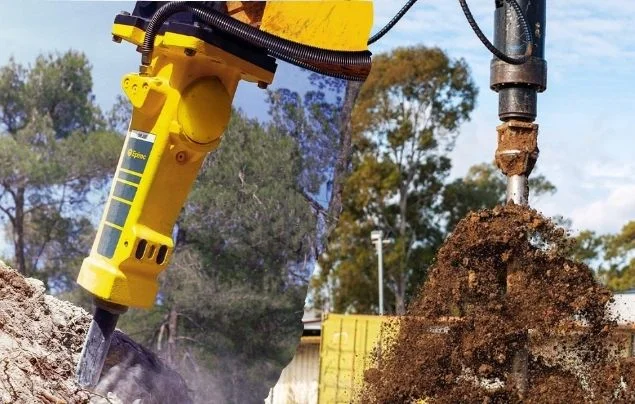
A good excavator does a lot. But what you put on the end of it is often what makes or breaks the job.
The right attachment can mean the difference between cutting a clean service trench in sandstone and burning through a shift with the wrong tool. Between processing demolition rubble on site and paying to cart it away. Between drilling a precise pier hole and struggling through an hour of repositioning.
Attachments have always been at the core of what we do at Hammer Hire. This guide covers what we stock, what each one is designed for, and the kinds of jobs where they earn their place. You can browse the full range on our excavator attachment hire page.
Hydraulic Hammers (Rock Breakers)
A hydraulic hammer — also called a breaker or rock breaker — attaches to the excavator arm and uses the machine’s hydraulic system to deliver high-impact blows to hard material. It’s one of the most commonly hired attachments we carry, and for good reason.
We stock hydraulic hammers from Epiroc and Toku across a range of sizes to suit different excavator classes.
Good for:
- Breaking concrete slabs, footings, kerbing and road surfaces
- Rock breaking — particularly sandstone, which turns up on a lot of Sydney sites
- Demolition of masonry and light structures
- Opening hard ground before bulk excavation
Matching the hammer to your carrier matters. Too small and it won’t move through hard material efficiently. Too large and you’re putting unnecessary stress on the arm. Mention your machine tonnage when you call and we’ll confirm the right spec.
For more on selecting the right hammer, see our hydraulic hammer hire page.
Auger Drives and Bits
An auger drive turns your excavator into a drilling platform. It mounts to the arm and rotates a helical bit into the ground to bore clean, accurate holes.
We stock auger drives from Digga, an Australian manufacturer built for local ground conditions, with bits available in a range of diameters to suit the job.
Good for:
- Post holes for retaining walls, fencing and signage
- Foundation pier drilling for residential and commercial builds
- Utility work requiring bored holes for pipes or conduit
- Tree planting on civil and landscaping projects
Ground type matters here. Clay, sandy fill, and rocky ground all behave differently under an auger. Let us know the soil conditions when you book and we can point you to the right bit.
See our auger drive hire page for what’s available.
Rock Saws (Austramac)
Our Austramac rock saw is a precision cutting attachment — a rotating diamond-tipped blade that cuts through rock, concrete, sandstone, and asphalt far more cleanly than a breaker.
We stock five Austramac models covering excavators from 1T to 35T. The blade is interchangeable and the stand rotates 360°, so you can cut left and right without repositioning the machine.
Good for:
- Trenching through sandstone or reinforced concrete in tight urban environments
- Pool, footing, and kerb excavation needing clean vertical faces
- Service trenching close to existing underground infrastructure
- Roadworks and civil cutting where vibration from a breaker would cause damage nearby
If the job is in a confined space, near existing services, or needs a clean face rather than a broken one, a rock saw is worth considering before defaulting to a hammer. We’ve covered this in more detail in our rock saw hire guide.
Pulverisers
A pulveriser crushes rather than breaks. It processes concrete, masonry, asphalt, and natural stone on site — reducing material to manageable pieces that can be reused or removed more efficiently.
Good for:
- On-site processing of demolition rubble and broken concrete
- Crushing masonry and natural stone
- Reducing material size to cut down on truck movements and disposal costs
- Recovering usable aggregate from demolished structures
Pulverisers are typically run on mid-to-large excavators. On a demolition site, they save the time and cost of loading and carting full-sized chunks.
See our pulveriser hire page for more detail.
Chain Cutters
A chain cutter is a high-precision attachment designed for trenching through rock and concrete. Where a rock saw makes a circular blade cut, a chain cutter uses a bar-and-chain system to produce a clean, narrow trench.
Good for:
- Precise trenching in hard rock or reinforced concrete
- Tunnelling and underpinning applications
- Jobs needing a narrow, accurate cut in constrained environments
Chain cutters work well where control and accuracy matter more than volume — service installation, utility upgrades, and jobs in built-up areas where adjacent structures need to stay undisturbed.
See our chain cutter hire page for availability.
Crusher Bucket
A crusher bucket mounts to the excavator like a standard bucket, but the jaw inside crushes material as it’s collected — turning concrete, brick, and rubble into manageable, reusable aggregate without a separate crushing plant on site.
We stock Epiroc crusher buckets in two sizes — the BC 2500 (22–30T carriers) and the BC 3700 (28–38T carriers).
Good for:
- Processing demolition rubble directly where it falls, rather than loading and carting it
- Producing reusable base material for backfill or road prep on the same site
- Quarrying and material recycling work
- Reducing truck movements and disposal costs on larger demolition jobs
If you’re running a demolition job with a lot of concrete or brick waste, a crusher bucket can turn a disposal cost into a usable material stockpile. Worth discussing at the quoting stage if volume is high.
See our crusher bucket hire page for specs and availability.
Rock Grab
A rock grab is a hydraulic clamp attachment built for picking up and placing large rocks, boulders, and awkward debris that a standard bucket can’t handle cleanly.
Good for:
- Sorting and placing rock in landscaping and retaining wall work
- Clearing large debris from demolition sites
- Forestry and land clearing where irregular material needs precise handling
- Loading oversized material that won’t sit in a bucket
The grip and control make this attachment useful anywhere you need to place material precisely rather than just move it — retaining wall construction is a common use case, where individual rocks need to be positioned rather than dumped.
See our rock grab hire page for what’s available.
Epiroc Specialist Attachments
Beyond hammers, our Epiroc range covers several specialist tools for demolition, recycling, and site prep. Epiroc is one of the world’s leading attachment manufacturers, and they’re the backbone of our specialist fleet.
Here’s what’s available:
Shears cut through structural steel cleanly — the go-to attachment when a demolition job involves steel framing, beams, or reinforcement that needs to be separated rather than crushed. We stock the SC 270, SC 2500 R, and SC 3600 R, covering a range of carrier weights.
Combi cutters do double duty — cutting and crushing concrete and steel in the one attachment. Useful on mixed-material demolition sites where switching between a shear and a pulveriser would slow the job down.
Compaction plates give you more control than bucket compaction when backfilling trenches or compacting fill around structures — particularly useful where access is tight and a roller can’t get in.
Drum cutters cut by profile rather than impact, which makes them the quieter, lower-vibration option for rock and concrete excavation near sensitive structures.
Screening buckets sort and separate material on site. Interchangeable mesh sizes let you screen topsoil, demolition waste, and aggregate without a separate plant.
Twin head rock grinders — also known as twin headers — use two rotating cutting heads to grind through rock and concrete with more control and less vibration than a hammer. This is the attachment to reach for when a site is too sensitive for a hammer but a rock saw’s straight-line cut isn’t what the job needs — the grinding heads follow more complex profiles than a rotating blade, which also makes them suited to underwater cutting applications.
Not sure which Epiroc attachment fits your job? Give us a call and we’ll talk it through.
Getting the Right Match
Every attachment has hydraulic flow requirements. If the carrier machine can’t supply what the attachment needs, performance drops — and equipment can be damaged.
When you book, it helps to know:
- Your excavator’s tonnage and brand
- The hydraulic flow rate your machine is set to
- The pin size or coupler type on the arm
If you’re hiring the excavator and attachment together through us, we sort the compatibility at booking. If you’re running your own machine, give us the specs and we’ll confirm fit before anything leaves the yard.
For safety guidance on operating plant and attachments on site, SafeWork NSW has practical information worth reviewing — particularly if your team includes less experienced operators. You can also check our post on excavator safety practices for a solid overview.
Ready to Go?
We stock attachments for excavators from 1.7T to 70T across Kubota, Kobelco, and CAT. Everything is serviced, site-compliant, and comes with full safety documentation including QR-linked risk assessments.
Browse the full range at our excavator attachment hire page, or call us on 1800 HAMMER and we’ll help you spec the right setup for the job. You can also head to hammerhire.com.au to explore our full fleet including excavator dry hire.
Related reading: Rock Saw Hire Sydney | Hydraulic Hammer Hire | Excavator Safety Practices | Excavator Dry Hire
Stay Updated with Hammer Hire
Sign up for our newsletter to get the latest articles, equipment tips, and exclusive offers straight to your inbox.

SUBSCRIBE NOW!
Fill in your details to subscribe.

