
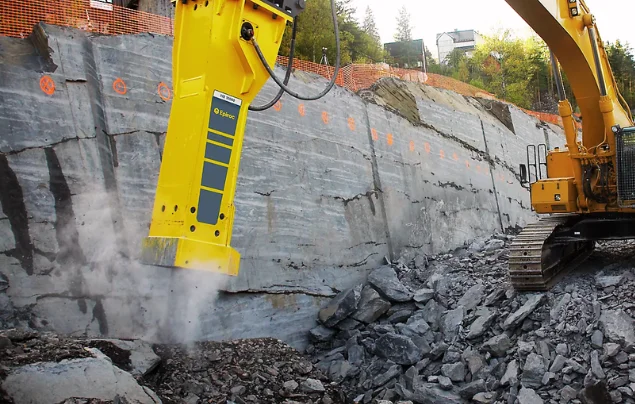
A hydraulic breaker might look like a straightforward attachment, big thing hits hard stuff, job done. But there’s more to it than that. Put the wrong class of breaker on a job and you’re either grinding through work at half the speed you should be, or you’re wearing out an attachment that wasn’t designed for what you’re asking of it.
HammerHire’s Epiroc hire range covers three classes: Solid Body, Medium, and Heavy. Each one is built for a different kind of work, and getting the match right makes a real difference on site. Details are at hammerhire.com.au/attachment-hire/atlas-copco-hydraulic-hammers, but here’s a plain breakdown of what each class is actually for.
Solid Body (SB) Breakers — Light Work, Tight Spaces
The SB range is built around a one-piece casing design Epiroc introduced in 1993, percussion mechanism and guide system in a single integrated unit, no bolted housing. It’s more compact and easier to position in confined areas than a conventional breaker of the same weight class.
These are the jobs the SB range handles well:
- Light concrete demolition, slabs, kerbs, small footings
- Asphalt cutting and removal
- Indoor demolition where noise and vibration need to be kept in check
- Underground scaling, knocking loose rock off tunnel walls and ceilings after blasting
- Foundry work, cleaning ladles and channels
The indoor/outdoor flexibility is genuinely useful. The same unit that pulls up a warehouse floor can work an exposed site the next day. And because SB breakers run on smaller carriers, they’re a natural fit for compact excavators, the right choice when you don’t want a large machine on site but still need to break material.
Medium Breakers (MB) — The Go-To for Most Construction Sites
Step up to the MB range and you’re working with meaningfully more impact energy. Epiroc describes these as ideal for concrete and asphalt demolition, secondary rock breaking, and primary rock excavation on construction sites. That covers a lot of the work contractors run into day to day:
- Reinforced concrete demolition, slabs, walls, retaining structures
- Secondary rock breaking, material that won’t load cleanly after excavation
- Primary rock excavation where blasting isn’t viable near buildings or services
- Hard material that shows up mid-scope and needs to be dealt with before earthworks can continue
Medium breakers pair best with mid-range excavators — typically 8T to 25T — which covers the most common carrier size on Sydney commercial and civil sites. If that’s your fleet, an MB class Epiroc is probably the right call for most breaking work.
Heavy Breakers (HB) — For When the Job Is Genuinely Hard
Heavy breakers aren’t just a bigger version of a medium — they’re a different tool for a different category of work. Epiroc’s HB range is designed for the applications where nothing lighter will do it properly:
- Primary blast-free rock excavation, working directly on unblasted rock face where blasting is ruled out near structures or services
- Secondary breaking of large blasted boulders in quarry and mining operations
- Primary demolition of heavy reinforced concrete, thick foundations, bridge elements, large retaining structures
- Surface and underground mine applications
These mount to larger carriers — 30T to 74T. HammerHire’s excavator fleet covers that full weight range, so if you need both the machine and the attachment, that can all come from the same place. It also means the pairing is correct from day one, which protects both the breaker and your carrier’s hydraulics.
One practical note on blast-free excavation: it’s become more common in urban areas where blasting creates too much risk near existing buildings, underground services, and residential properties. In those situations, a heavy breaker on a large excavator is often the only realistic option for primary excavation.
Is It Better to Hire or Own a Breaker?
For most contractors, hiring makes more sense than owning, especially if breaker work is intermittent rather than ongoing. Hydraulic hammers need consistent maintenance: tool steel condition, nitrogen gas pressure, internal sealing, bushing wear. Get any of that wrong and you’re not just damaging the attachment, you’re potentially damaging your carrier’s hydraulic circuit too.
When you hire through HammerHire, the in-house technicians have already checked the attachment before it goes out. You’re getting a breaker that’s ready to work from the moment it arrives, not one that’s been sitting in a yard since the last job.
Other Attachments We Can Help With
If the job calls for something other than a breaker, the full attachment hire range also covers Toku hydraulic hammers, diamond rock saws, chain cutters, bucket crushers, bucket screeners, rock grabs, auger drives and bits, pulverisers, twin header rock grinders, combi cutters, and steel shears. Having everything under one roof makes life easier when a project scope shifts mid-job.
Not Sure Which Class You Need?
It’s a fair question, especially when material hardness varies, your carrier sits between two standard weight brackets, or the site conditions aren’t fully known yet. The HammerHire team deals with this regularly and can help you work it out before hire day.
Call 1800 HAMMER or head to Epiroc hydraulic hammers to enquire.
Stay Updated with Hammer Hire
Sign up for our newsletter to get the latest articles, equipment tips, and exclusive offers straight to your inbox.

SUBSCRIBE NOW!
Fill in your details to subscribe.

